
Law, Property, and Belonging
News of the WorldThis thread follows the novel’s contrasting systems of law and ownership, from contested land titles to children and animals treated as property.
increasing Bearing strength in each event
 decreasing
Bearing strength in each eventdecreasingA Land Grant in Doubt

A Land Grant in Doubt
Inherited claims
Kidd explains that his late wife’s family holds a Spanish land claim whose registration was never completed in Mexico City. Later governments have inherited the unresolved paperwork.
Law as a fragile record
The title’s uncertainty reflects how political change can make ownership depend on documents and institutions. Kidd’s daughter Elizabeth sees research as a possible path through that instability.
A Child Valued as a Commodity
A Child Valued as a Commodity
A forced exchange
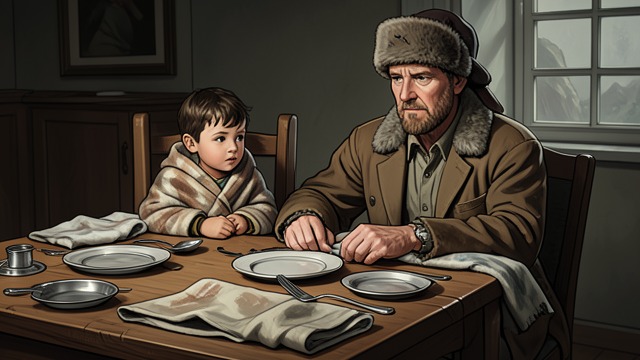
The Kiowa surrender captives under pressure from the Indian Agent, and Cicada is exchanged for blankets and silverware. The transaction converts a child’s identity and attachments into negotiable goods.
The limits of official rescue
Government procedure can return Cicada to white relatives without ensuring that those relatives will care for her. The novel distinguishes legal custody from the harder question of genuine belonging.
Coins as Ammunition
Coins as Ammunition
Money changes function
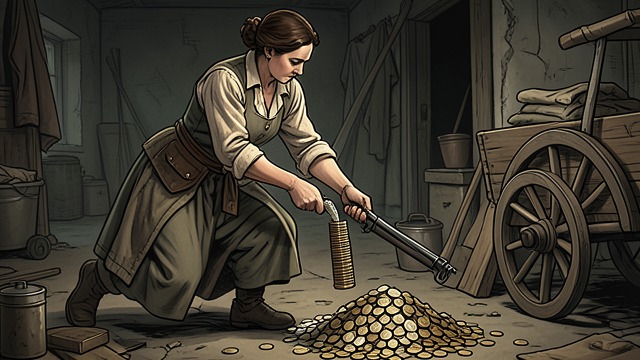
Cicada treats the collected coins as usable material and loads dimes into shotgun shells. In the emergency, money becomes literal ammunition rather than an abstract measure of value.
Resourcefulness over convention
The improvised weapon saves the travelers from attackers. The episode shows how their differing habits of use can become complementary strengths under pressure.
The Chickens’ Cost

The Chickens’ Cost
Different ideas of ownership
Cicada kills and prepares the broommaker’s chickens as food, not recognizing the act as theft in the way Kidd does. Their disagreement emerges from different assumptions about animals and private property.
Repair through conscience
Kidd later pays an intermediary to return money for the hens. His action cannot undo the misunderstanding, but it shows his effort to make shared life answerable to both custom and conscience.
Hammurabi’s Standard
Hammurabi’s Standard
A question about justice
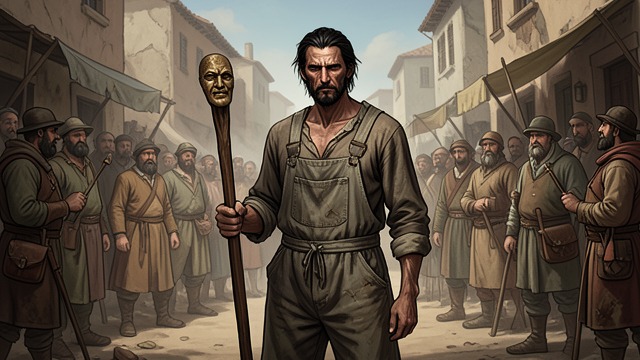
John Calley asks Kidd whether law rests on any stable ground amid political instability. Kidd answers with a maxim attributed to Hammurabi: law should be public, simple, and apply to ruler and ordinary person alike.
A moral contrast
The maxim stands against the arbitrary power Kidd encounters on roads and in local politics. It gives Calley a principle to carry forward as he seeks honest work.
During Kidd’s letter to his daughters in Dallas
Winter 1870, during the transfer at Fort Sill
March 1870, at Carlyle Springs
Night after the Durand reading
March 1870, after the Durand riot
